When Liberty Becomes an Exception How Arbitrary Power, Racial Profiling, and Constitutional Amnesia Are Reshaping the American Republic
https://sukiraninsights.substack.com/p/america-against-itself-when-liberty
There are moments in a nation’s life when the language it uses to describe itself begins to ring hollow—not because the ideals have changed, but because the distance between principle and practice has become impossible to ignore.
The detention of George Retes, a U.S. citizen and Army veteran, by federal immigration authorities is not merely a story of bureaucratic error or individual misconduct. It is a diagnostic event. It reveals something structural, something corrosive, about the contemporary American state and its relationship to its own constitutional inheritance.
Retes’s experience—tear-gassed, pepper-sprayed, pinned with a knee on his neck, detained without charge, denied counsel, denied communication, denied even the basic dignity of washing chemical irritants from his body—belongs more naturally to the political vocabulary of authoritarian regimes than to a republic that once defined itself as the global custodian of civil liberties.
What makes the episode especially disturbing is not only that it happened, but that it happened routinely, without evident panic, without institutional alarm, and without immediate consequence for those responsible.
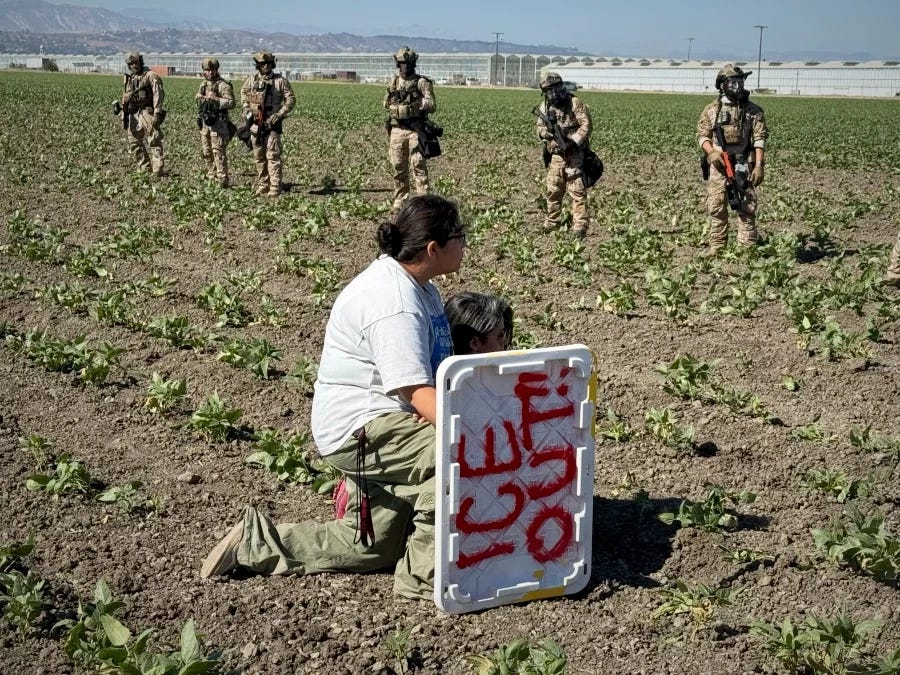
For generations, America taught both itself and the world that the rule of law was its civilizational signature. Power was legitimate precisely because it was constrained; authority was respected because it was accountable; coercion was acceptable only insofar as it was bounded by due process. Yet what the ICE raids described in The Atlantic reveal is a quiet inversion of that tradition: the normalization of state power that acts first and justifies itself later, if at all.
When citizens are detained based on how they look, when due process becomes optional, and when courts refuse to notice discrimination, the Constitution ceases to be a shield and becomes a condition. At that point, liberty is no longer a right guaranteed by citizenship; it is a performance demanded by power, withdrawn at discretion.
The problem is not confined to immigration enforcement. Immigration has merely become the testing ground—the frontier zone—where constitutional guarantees are thinned, suspended, or rendered conditional. Historically, this is how democratic backsliding begins. Rights are not abolished wholesale; they are selectively ignored.
They are first denied to the marginal, then to the inconvenient, and finally to anyone who cannot instantly prove their innocence to armed agents operating with discretionary authority.
Adam Serwer’s argument that America is drifting toward an “Antebellum Constitution” is therefore not rhetorical exaggeration. It is historically precise. The antebellum constitutional order was not lawless; it was selectively lawful. It protected property more zealously than persons, hierarchy more than equality, and power more than dignity. Its central moral failure was not incoherence, but exclusion: the belief that constitutional protection was a privilege of identity rather than a guarantee of citizenship.
What is striking—and deeply unsettling—is how easily contemporary practices echo that logic. When federal officers openly admit that they detain individuals based on “how they look,” when courts tolerate racial profiling under the euphemism of “reasonable suspicion,” when citizens are told, implicitly or explicitly, that carrying proof of belonging is their responsibility, the Constitution ceases to be a shield and becomes a conditional document. At that point, liberty is no longer a right. It is a performance.
The danger is compounded by judicial acquiescence. When courts refuse to notice discrimination unless it is confessed, when they elevate state sovereignty above human dignity, when they treat the erosion of equal protection as a technical dispute rather than a constitutional emergency, they are not neutral arbiters. They become participants in the dismantling of equal citizenship. Law remains, but justice recedes.
It is at this juncture that a deeper question must be asked—one that goes beyond legality and reaches the level of national character.
Nations endure in ways that ideologies do not. Parties rise and fall, doctrines gain followers and then recede, leaders dominate an era and are later reduced to footnotes. Yet nations persist long after the slogans have faded and the banners have been lowered. What survives is not the personality of a ruler or the popularity of a movement, but the moral record a nation leaves behind.
True nationalism, therefore, is not loyalty to a faction or obedience to a momentary political mood. It is fidelity to national principles—those norms and restraints that preserve a nation’s honor across generations. It demands that state power be exercised in ways that protect the dignity and welfare of the entire political community, not merely those who conform to a preferred identity, ideology, or appearance.
Nations outlast leaders, parties, and ideologies. What endures is their moral record. True nationalism is not loyalty to a faction or obedience to a ruler, but fidelity to principles that protect the dignity of the entire political community. By that standard, arbitrary detention and racial profiling do not defend the nation—they dishonor it.
Judged by this standard, the conduct of immigration authorities in the recent ICE raids is not simply a legal failure but a national disgrace. To arbitrarily detain citizens, to suspend due process, to normalize racial profiling, and to treat constitutional rights as inconveniences is to erode the very foundations that allow a nation to claim moral legitimacy. Such actions do not defend the nation; they dishonor it.
It may not trouble Americans that the world dislikes Donald Trump as an individual leader. Leaders are transient. But it should deeply trouble them if America itself comes to be associated with cruelty, arbitrariness, and legalized humiliation—if the republic is remembered not for correcting its excesses but for institutionalizing them. Apartheid-era South Africa was not defined solely by the men who governed it, but by the system it tolerated. A similar stain would not attach to a presidency alone, but to the nation that allowed it to endure.
Future generations will not struggle to understand the legal technicalities of this moment. They will struggle to understand its moral complacency. They will ask how a society so saturated with constitutional rhetoric could tolerate such casual violations of its own foundational promises.
They will wonder why a nation that commemorates civil-rights martyrs with holidays could watch the slow erosion of due process with indifference. And they will likely feel a quiet, persistent shame that the collapse did not arrive with tanks or decrees, but with administrative memos, emergency dockets, and bureaucratic silence.
America has always lived with contradictions, but it once possessed a moral grammar for confronting them. The Reconstruction Amendments were born from catastrophe, but they represented an ethical advance: the explicit recognition that citizenship must be universal, rights must be enforceable, and power must be answerable to the least protected. To hollow out those amendments in the name of “order,” “originalism,” or “common sense” is not constitutional fidelity. It is constitutional sabotage disguised as restraint.
The tragedy is that this path does not lead to greater security or cohesion. History is unambiguous on this point. Systems that govern through fear, profiling, and exclusion ultimately degrade everyone’s freedom. They produce not order, but fragility; not unity, but resentment; not strength, but moral exhaustion. The antebellum order did not protect ordinary white Americans from exploitation, poverty, or oligarchy. Nor will its modern reincarnation.
Future generations will not struggle to grasp the legal technicalities of this moment. They will struggle to understand the moral complacency that allowed it. They will ask how a republic built on liberty tolerated arbitrary power so easily—and why the erosion of rights arrived not with tanks, but with silence.
If America continues down this road, the question will no longer be whether it lives up to its ideals, but whether it still believes in them at all. A republic that teaches its children about liberty while practicing arbitrary detention teaches cynicism, not patriotism. A Constitution treated as a technical obstacle rather than a moral commitment becomes what James Madison feared most: a parchment barrier, impressive in language and empty in force.
George Retes survived his ordeal. Many others will not be so visible, so documented, or so fortunate. But the larger issue is not his suffering alone. It is the precedent his suffering sets.
Nations are remembered not only for what they proclaim, but for what they permit. And unless this trajectory is confronted—legally, morally, and politically—future Americans may find themselves explaining, with disbelief and discomfort, how the land of liberty learned to look away from itself.
For more essays on geopolitics, civilizational issues, democracy, moral politics please visit the following website
https://sukiraninsights.substack.com/
Comments